A Maryland Electrician’s Guide to Outdoor Outlets, Circuits, and Timers
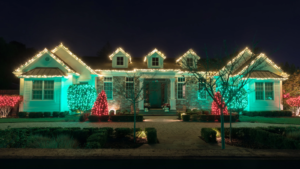
Most people plan their holiday lights around the look they want, whether that’s a simple roofline or a full yard display. Fewer think about where everything will plug in.
In many homes, residents find one outdoor outlet by the front door that ends up powering the porch, the bushes, the gutters, and an inflatable in the yard. When a breaker trips on the first cold, wet night, someone spends the evening unplugging strands to find the one that caused it.
When Maryland and DC homeowners call us before the season, our electricians look at the outlets, the circuits, and how the lights will be controlled.
Start With the Outdoor Outlet
Every outdoor outlet should have GFCI (ground fault circuit interrupter) protection that shuts off power in a fraction of a second when current leaks to ground, which can happen when rain or melting snow reaches a plug. You’ll recognize a GFCI by the Test and Reset buttons on its face. Some outdoor outlets are protected by a GFCI located elsewhere, often in a garage or bathroom, so if yours has no buttons, it’s worth finding out what’s protecting it.
Push the Test button before you hang anything. The power should cut off, and Reset should bring it back. If it doesn’t trip, or won’t reset, the device needs to be replaced.
The cover matters too. Older homes often have flat flip-up covers that only seal when nothing is plugged in. Current code calls for an in-use cover on wet location receptacles. It’s a deeper, bubble-style housing that stays closed over the cord so the outlet is protected all season.
A few outdoor outlet upgrades we install often this time of year:
New outlets where you need them. Adding a receptacle near the garden beds or on the far side of the house reduces long cord runs across the lawn.
Soffit or eave outlets. An outlet tucked under the roof overhang makes powering roofline holiday lights much easier. Many homeowners have it wired to an interior switch so they can turn the display on and off from inside.
Weather-resistant GFCI receptacles with in-use covers. These replace worn or outdated outlets and hold up better through Maryland winters.
Know What the Circuit Can Handle
Outdoor outlets often share circuits. It may share a breaker with the garage, a bathroom, or a bedroom. If you plug in a space heater indoors while the display runs, you can exceed the limit without realizing it.
LED strands draw very little power, so a modest display usually isn’t a problem on its own. Larger setups with inflatables, light projectors, animated pieces, or older incandescent strands add up faster. Our post on understanding your home’s electrical panel explains how to read your breaker labels and see what shares a circuit.
For bigger displays, a dedicated outdoor circuit is the most reliable setup. Your lights get their own breaker, and a trip outside won’t knock out power to a room inside.
Call an electrician if you notice any of these:
A breaker or GFCI that trips repeatedly, even after you’ve cut back on what’s plugged in
An outlet, cover plate, or plug that feels warm
Lights that flicker or dim when something else in the house turns on
A GFCI that won’t reset, or scorch marks around an outlet
Put Your Holiday Lights on a Schedule
A timer turns your lights on at dusk and off at bedtime, so you don’t have to remember whether they ran all night. It also trims your electric bill and keeps the strands from running 24 hours a day.
Outdoor-rated plug-in timers are inexpensive and work well for small displays. Photocell timers turn on automatically when it gets dark, so you don’t have to adjust them as the days get shorter. For a cleaner setup, we can install a smart switch that controls a soffit outlet or an entire outdoor circuit. You set schedules from your phone, and the same switch works for patio string lights or landscape lighting the rest of the year.
Outdoor smart plugs need an outdoor rating. Plug them into a GFCI-protected outlet that has an in-use cover.
Cords and Connections
Extension cords should be marked for outdoor use, with a gauge heavy enough for the run length and load. Raise plug connections off the ground so they don’t sit in puddles or snow. Running a cord through a window or door can pinch it, so look for another route. As you unpack your strands, toss any with cracked sockets or frayed wires. For more tips, see the holiday safety pages from the Electrical Safety Foundation International and SafeElectricity.org.
Permanent Exterior Lighting for Year-Round Curb Appeal
If you’re tired of hauling out the ladder every November, permanent exterior lighting stays on the house year-round. The same fixtures handle your December display and light the house the rest of the year.
A common choice is a permanent LED roofline system – small fixtures mounted in a low-profile track along the fascia or soffit and hard to spot during the day. Most systems are controlled by an app. You might run warm white most nights, switch to red and green in December, and pick team colors on game day. Nothing comes down after the holidays, so you won’t have tangled strands to sort out next fall.
Landscape lighting can improve your home’s evening curb appeal and safety. Low-voltage path lights, uplights on trees, and wall washers on stone or brick light up the yard after dark and make walkways safer. These systems run from a transformer connected to a GFCI-protected outdoor circuit, and they can run on the same timer or smart controls as the roofline lights. Our post on landscape lighting covers fixture types and placement.
Permanent systems need a properly located power supply, usually near the soffit or in the attic, plus a circuit with enough capacity for the lights and anything else that shares it. Many homeowners add a dedicated outdoor circuit and a switch or smart control inside so the whole system can be managed in one place. TriStar Electric installs the outlets, circuits, and controls these systems depend on, along with landscape lighting, LED lighting, and residential flood lighting for homes throughout Maryland and DC.
Working With Holiday Lighting Installers
Many homeowners hire a decorating company to hang their holiday lights. Those crews handle the design and hanging, and they work with whatever power the house already has.
We also work with professional light installers who want reliable power at their clients’ homes. Adding soffit outlets, extra GFCI receptacles, or a dedicated circuit before installation day makes their job easier and the display more dependable. If you hang lights for a living in Maryland or DC, we’re happy to be the electrician you refer clients to.
Get Ready Before the Rush
TriStar Electric serves homeowners across Maryland and Washington, DC. Our licensed electricians handle outdoor outlet installations, new circuits, smart switch wiring, and troubleshooting and repair when something isn’t working the way it should. If you’re new to your home’s wiring, our beginner’s guide to electrical wiring covers the basics.